Posts

Showing posts with the label Habitat

Goose Stepping Crows

Image
I was back in Deception Pass State Park this week watching crows at West Beach again. This pair of Northwestern Crows (Corvus caurinus) came marching by in an orderly, military manner.  Their steps were in perfect unison as if a marching band was playing. Zooming in on the above photo reveals feathers and fibers being carried in their beaks.  I presume these are being collected for use as nesting materials.  This is apparently a cooperative effort by the pair. Northwestern Crows could be classified as shorebirds. They nest and make their living around salt water beaches and estuaries.  It is common to spot them foraging for mussels, clams  and snails on rocky beaches at low tide.  They are distinguished from American Crows by a smaller size and deeper voice.

Up With the Crows

Image
Two days ago, we experienced a fairly significant wind storm.  It is an odd time of the year for this.  Such a storm is typical for November, but not April.  Early yesterday morning, I headed over to West Beach in Deception Pass State Park to see what the surf was like.  The conditions there can be just like open ocean. Off the Strait of Juan de Fuca it was still windy in the park, with only moderate surf.  Next to Cranberry Lake, I encountered a pair of Northwestern Crows (Corvus caurinus) .  One was perched on the bench of a picnic table.  He was preening wet, spiky feathers.  Apparently, he had just finished a bath in the lake. "Do you mind?" "Alley-Oop!" Northwestern Crows are a bit smaller than their cousin the American Crow and have a deeper voice.  They nest and make their living around salt water beaches.  Like gulls, they will fly up and drop mussels, clams, and snails onto rocks (or concrete sidewal...

Mycophagy

Image
Mycophagy (my-COUGH-a-gee) is an interesting word derived from Greek meaning "fungus glutton."  Our native Banana Slugs (Ariolimax columbianus) are apparently mushroom epicures.  Hiking the North Trail in the Kukutali Preserve I spotted the mollusks dining on our local portobellos.  With October, the rains have returned, and damp weather seems to bring out both slugs and mushrooms. All along the trail, I found evidence of mushroom munching.  It was obvious the slugs relish these mycological delights. I do not recommend following their lead.  I don't know enough about mushrooms to declare these safe for people to eat.  What is dessert for slugs could be deadly for humans.  It seems the slugs have evolved to cope with potential toxins produced by the fungi.  It is well known people have not. At this point, allow me to editorialize.  Wherever I hike, I find smashed and dead Banana Slugs.  Hikers seem to be going out of the...

Heron Luncheonette

Image
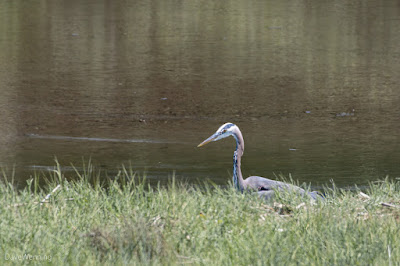
On Memorial Day I hiked around the Kukutali Preserve .  It is a favorite and convenient spot for me, quick and easy to get to and I always find something interesting there.  At the end of the hike, I headed back along the tombolo connecting Kiket Island to the mainland.  There is a lagoon on the north side of the tombolo.  Over the bank separating the roadway from the lagoon, I spotted a Great Blue Heron (Ardea herodias) giving me the eye. In itself, seeing a heron around here is not unusual.  What did strike me as odd, I was well inside the " escape zone " from which herons will usually flee, barking in protest.  This one did not flee, however, but remained in place watching me. As I continued along the tombolo, I got even closer and was able to get a better view of the bird.  It was wading belly deep in the lagoon.  Still, it did not flee from me.  It just stood there motionless. Then, quite suddenly, the bird plunged its h...

Black Oystercatcher at Kukutali Preserve

Image
Just across Skagit Bay from my home is Kiket Island and the smaller Flagstaff Island attached to it by a tombolo .  The islands now comprise the Kukutali Preserve .  It is owned and operated jointly by the Swinomish Tribal Community and Washington State Parks.  Until this week, access to the Preserve was limited to small guided groups by reservation only.  It is now open to the public and I made my first unescorted visit last Tuesday.  You can read about my visit and the history of this newly opened nature preserve at Fidalgo Island Crossings . With a good low tide, I returned this morning with a specific objective.  I wanted to see if the Black Oystercatchers (haematopus bachmani) I first met three years ago are still living at Flagstaff.  I spotted a pair calling and flying low over the bay towards Skagit Island on Tuesday. Sure enough, today I was rewarded by another encounter with one of my old friends.  Oystercatchers are non-migrat...

Visitor-Friendly

Image
Bald Eagle (Haliaeetus leucocephalus) I had a visitor on Saturday.  I have had many encounters with Bald Eagles in and around my yard, but this one was special.  He has found a perch on one of the small firs growing at the front edge of the property. The lighting around this tree is not very good for photography.  The view of the photo is to the south.  Some of the problems photographing dark birds against a bright background are apparent.  Nevertheless, this eagle perched in my tree is a welcome sight. There was once a wonderful eagles' hunting perch at the edge my neighbors' yard right next to mine.  The birds visited this tree almost daily.  It gave them a good view of Skagit Bay where they could scan the waters for fish.  I have had the privilege of watching them catch fish many times.  The tree also made a perfect photography subject, especially in the afternoon.  The visiting birds would be lit by the western sun.  I c...

Robin Thinks He's a Shorebird

Image
On Labor Day, I took a nice long hike up the beach into Similk Bay .  I never know what I will encounter on my beachcombing treks.  I certainly did not expect to find this American Robin (Turdus migratorius) .  He was busy patrolling the driftwood that had collected along the shoreline. Silly Robin!  You don't belong on the beach.  This is the place for Gulls and Oystercatchers and Northwestern Crows.  Canada Geese, Ravens and Herons use this place.  Sandpipers and Killdeer live here.  It's not for thrushes like you.  Your place is open woods, forest edges and meadows, gardens and city parks.  You should not be hopping around the driftwood on a salt water beach. Well, look at this.  You found a tasty bug in the rotted center of that driftwood stump.  You have also been getting into those ripe blackberries growing along the shore.  I can tell by the stains on your beak.  I guess you belong here after all...

More Baby Pictures

Image
I was wandering around the yard checking out the garden to see what was blooming.  I had the Canon 7D and the 100 mm macro lens with me.  Behind some big rhododendrons there is an empty shaded spot where I am working on some ideas.  In the corner of my eye I caught movement and something brown.  That neighbor's cat is here , I thought.  Then suddenly, this little fellow came rompity-stomping right up to me!  He was only about five feet away, almost too close for the lens. His reaction was a mix of curiosity and wariness.  My reaction was f-stop, f-stop!  He ran up the bank to the driveway, stopped and stared at me for a moment.  Then he scampered back down to get a closer look again.  He continued to move around me as if to check me out from every angle.  He was a tiny little guy, no taller than a Border Collie.  But he was full of spirit, bold and curious.  I am probably the first human he's laid eyes on up close....

Tree Swallow

Image
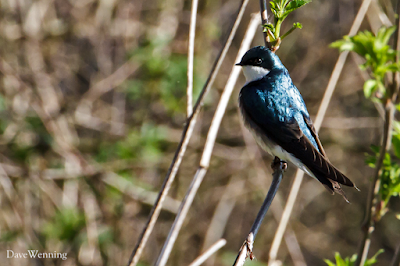
Last week, I was pleased to see the Tree Swallows ( Tachycineta bicolor ) had returned to my favorite Fir Island nature site.  This is the Spur Dike Trail at Wiley Slough in the Headquarters Unit of the Skagit Wildlife Area .  The dike provides easy, dry ground access deep into the wetlands of the Skagit River delta.  Tree Swallows migrate north from their tropical wintering areas earlier than any other swallow. The scientific binomial Tachycineta bicolor literally means "fast mover with two colors."  Tree Swallows are indeed fast movers.  They typically feed by catching insects on the fly, soaring and swooping at lightning speed.  Unlike eagles and gulls which like to perch and pose for photos, these swift birds are difficult to catch with a camera.  They might land and perch for only a moment, then dash off on the fly again to the tune of their high-pitched calls. Fortunately, one bird decided to stop and rest a minute.  Although the li...