Posts

Showing posts with the label Nuthatches

Flickering

Image
Yellow-shafted Northern Flicker  Since November, the Northern Flickers ( Colaptes auratus ) visiting the BirdCam station have all appeared to be of the "Yellow-shafted" morph.  The bird above clearly has yellow-shafted tail feathers, gray crown and tan cheeks.  The problem has been the lack of a red nape chevron also characteristic of the Yellow-shafteds.  Hmmm. Some references put Yellow-shafted birds in the East and Red-shafteds in the West with hybrids found in the Great Plains or Rocky Mountains.  This is obviously too simplistic.  More complete sources indicate that the Yellows are found in the eastern U.S., western Canada and Alaska.  No doubt, we benefit here from our proximity to western Canada.  We are only 30 miles/48 km due east of Victoria, B.C., and about 50 miles/80 km south of Vancouver. Red-shafted Northern Flicker Male Beginning New Year's Day, Red-shafted Northern Flickers started to visit the station.  This bird ...

Snow on Sunday

Image
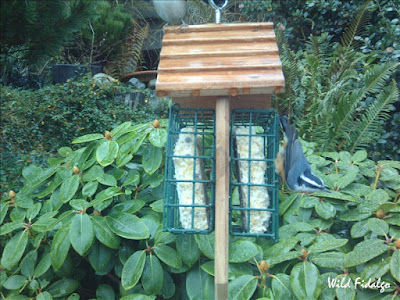
Red-breasted Nuthatches ( Sitta canadensis ) Red-breasted Nuthatches make a warm spot on a snowy Sunday.

Égalité

Image
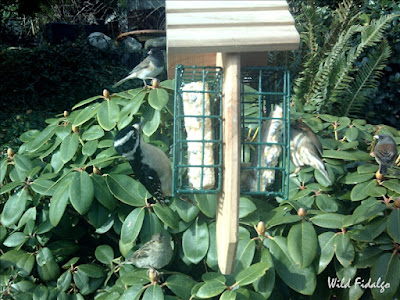
"Birds of a feather flock together" gives way to "all are created equal."  Here is a gallery of BirdCam multicultural group shots from October and November, The Enlightenment in action.  Some in this country should take a lesson.  This is a list of the birds in the photos: Chestnut-backed Chickadee ( Poecile rufescens ) House Finch ( Carpodacus mexicanus ) Dark-eyed Junco ( Junco hyemalis ) Red-breasted Nuthatch ( Sitta canadensis ) House "English" Sparrow ( Passer domesticus ) Downy Woodpecker ( Picoides pubescens)

Red-breasted Nuthatch

Image
Red-breasted Nuthatch ( Sitta canadensis ) If you are seeking "cute," consider the Red-breasted Nuthatch (Sitta canadensis ).  But don't be misled by looks.  This athletic little bird is all business.  You will never catch them in an idle moment.  They are also fearless.  If I am working near the feeders, they boldly fly in without concern.  iBird reveals some interesting facts: An extended hind toe and short tail aid in running around the sides of trees. They hoard food by hammering it into the bark of trees. They put sticky pitch around their nest holes, apparently to discourage predators, pests or rivals. A group of nuthatches is know as a "jar." On South Fidalgo, they are more numerous in the fall and winter, apparently migrants from their mountainous nesting areas.  They prefer conferous forests and dig nest holes in dead trees or snags.  Males have a black cap.  Females have a gray cap and their rust undersides are p...