Posts

Showing posts with the label Behavior

Size Matters

Image
This Columbian Black-tailed Deer (Odocoileus hemionus columbianus) is one of several that have visited my yard here in the middle of Anacortes, Washington.  They appear to be abundant all over Fidalgo Island.  My previous home on the south shore of the island was literally on a deer trail.  They were daily visitors year-around.  I have now lived in town for three months, and observed the same behavior here.  I recognize three adult does and one young buck along with three fawns from this season. This mature gentleman that visited yesterday afternoon was new to the yard.  His thick neck and well-developed antlers indicate a male ready for the mating season.  He came out of the woods chasing a doe.  When she eluded him, he spent some time in the lawn appearing befuddled.  He looked around as if trying to decide what to do next.  You will notice something else peculiar about this guy, as I did. Some kind of net material was firm...

Empty Nest

Image
In the neighborhood where I lived not so long ago, we had our own Bald Eagles' nest.  It is invisible from the ground.  It's possible that the people living in the houses at the base of the tree are unaware of its presence.  These days, if you own property that hosts an eagle's nest, you might not be allowed to build there.  In this case, the houses were there first.  The birds came and built a nest right over them.  Seattle hosts several nesting pairs within the city limits.  It might be a myth that eagles won't tolerate humans living in their nesting areas. If you know where to go and look, the nest can be observed, but it still isn't easy.  You must venture onto private property.  My neighbor kept me up to date on the goings-on there with reports and photos.  We knew there were two youngsters in the nest this year. In early morning August 1, I returned to the old neighborhood.  I went hiking on Kiket Island in the Kukut...

Goose Stepping Crows

Image
I was back in Deception Pass State Park this week watching crows at West Beach again. This pair of Northwestern Crows (Corvus caurinus) came marching by in an orderly, military manner.  Their steps were in perfect unison as if a marching band was playing. Zooming in on the above photo reveals feathers and fibers being carried in their beaks.  I presume these are being collected for use as nesting materials.  This is apparently a cooperative effort by the pair. Northwestern Crows could be classified as shorebirds. They nest and make their living around salt water beaches and estuaries.  It is common to spot them foraging for mussels, clams  and snails on rocky beaches at low tide.  They are distinguished from American Crows by a smaller size and deeper voice.

Up With the Crows

Image
Two days ago, we experienced a fairly significant wind storm.  It is an odd time of the year for this.  Such a storm is typical for November, but not April.  Early yesterday morning, I headed over to West Beach in Deception Pass State Park to see what the surf was like.  The conditions there can be just like open ocean. Off the Strait of Juan de Fuca it was still windy in the park, with only moderate surf.  Next to Cranberry Lake, I encountered a pair of Northwestern Crows (Corvus caurinus) .  One was perched on the bench of a picnic table.  He was preening wet, spiky feathers.  Apparently, he had just finished a bath in the lake. "Do you mind?" "Alley-Oop!" Northwestern Crows are a bit smaller than their cousin the American Crow and have a deeper voice.  They nest and make their living around salt water beaches.  Like gulls, they will fly up and drop mussels, clams, and snails onto rocks (or concrete sidewal...

The Early Bird and the Worm

Image
The other day, I made an early morning visit to West Beach in Deception Pass State Park.  There is a short trail from the parking lot that heads over to the amphitheater and the beach on Deception Pass.  I wanted to see how the bridge looked.  On the trail, I ran into this fellow, an American Robin    (Turdus migratorius) .  I was surprised that he allowed me to get as close as I was without flying off.  He wasn't even paying attention to me.  Sometimes park critters become accustomed to having people around. Then I noticed why he was standing his ground.  He was working on an earthworm  for his breakfast.  They are one of the annelids or segmented worms.  From my observations, they are a favorite food of Robins.  When I am planting or digging in the garden, the birds will gather in a perimeter around me.  As soon as I leave, they will fly in to snatch the goodies I kicked out of the soil.  They have lea...

Mycophagy

Image
Mycophagy (my-COUGH-a-gee) is an interesting word derived from Greek meaning "fungus glutton."  Our native Banana Slugs (Ariolimax columbianus) are apparently mushroom epicures.  Hiking the North Trail in the Kukutali Preserve I spotted the mollusks dining on our local portobellos.  With October, the rains have returned, and damp weather seems to bring out both slugs and mushrooms. All along the trail, I found evidence of mushroom munching.  It was obvious the slugs relish these mycological delights. I do not recommend following their lead.  I don't know enough about mushrooms to declare these safe for people to eat.  What is dessert for slugs could be deadly for humans.  It seems the slugs have evolved to cope with potential toxins produced by the fungi.  It is well known people have not. At this point, allow me to editorialize.  Wherever I hike, I find smashed and dead Banana Slugs.  Hikers seem to be going out of the...

Black Oystercatchers Nesting

Image
I consider the pair of Black Oystercatchers (Haematopus bachmani) that make their home in the Kukutali Preserve to be friends.  I have been watching them since 2011 , the first time I visited.  I'm fairly certain I have been seeing the same birds every year.  According to BirdWeb , "Males and females appear to form long-term pair bonds, and the pair returns to the same territory year after year." I was in the Preserve yesterday and found them in their usual spot, where they appear to be nesting now.  They seem to nest later in the season than other birds.  I'm not certain, but perhaps it's a shorebird thing.  Land birds are pretty much done with that now, or even getting ready for a second brood.  Oystercatchers lay their eggs in a simple scrape in the rocks, above the high tide line, according to the iBird app . While I walked up the beach to the west, I pointed the camera at some gulls that were still quite a distance away.  Only th...

Eyes of the Day

Image
I'll begin with a mystery.  On a hike in the Kukutali Preserve , I couldn't help but notice all the daisies blooming along the road.  A dark object on one of them caught my eye.  Looking closer, I knew I should get a photo of it.  I figured out it was a Harvestman , but I don't know what kind. Another name for them is "Daddy Longlegs," but this is like no Daddy Longlegs I have ever seen.  Wikipedia says, "typical body length does not exceed 7 millimeters (0.28 in)."  This one was at least twice that size.  I do get the delicate little Daddy Longlegs in my house.  They seem to like my shower.  My house guests, however, have tiny bodies that are under a quarter inch long.  Perhaps Kiket Island grows them extra large and robust.  I would enjoy hearing from anyone who can provide more information about this big guy. Harvestmen are arachnids like spiders and scorpions, but of a different order, Opiliones.  They have eight leg...

Heron Luncheonette

Image
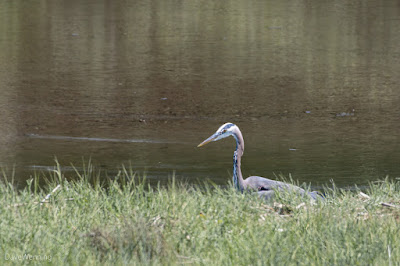
On Memorial Day I hiked around the Kukutali Preserve .  It is a favorite and convenient spot for me, quick and easy to get to and I always find something interesting there.  At the end of the hike, I headed back along the tombolo connecting Kiket Island to the mainland.  There is a lagoon on the north side of the tombolo.  Over the bank separating the roadway from the lagoon, I spotted a Great Blue Heron (Ardea herodias) giving me the eye. In itself, seeing a heron around here is not unusual.  What did strike me as odd, I was well inside the " escape zone " from which herons will usually flee, barking in protest.  This one did not flee, however, but remained in place watching me. As I continued along the tombolo, I got even closer and was able to get a better view of the bird.  It was wading belly deep in the lagoon.  Still, it did not flee from me.  It just stood there motionless. Then, quite suddenly, the bird plunged its h...