Posts

Showing posts with the label Finches

American Goldfinch

Image
The American Goldfinch (Spinus tristis. a.k.a. Carduelis tristis)  is the Washington State Bird.  I have been trying to get a decent photo of one for almost 10 years.  That makes this encounter yesterday in the Kukutali Preserve somewhat momentous for me. These are wary, fast moving little birds that will flee at the sight of a human.  Up until now, I have only been able to observe them from afar or using the BirdCam.  This bird allowed me to stand within about 10 feet/3 meters while he took a meal of Hawksbeard seeds. From these photos, notice how he never took his eye off of me.  If I had made one wrong move, he would have been gone in an instant. This is a male, identified by his bright yellow breeding plumage and black cap.  Females are a duller olive brown color and lack the black cap.  In winter, both genders are olive brown.  I usually see them in small groups or "charms," but this bird was feeding alone. The State o...

Life and Death at Kukutali

Image
December 1 is the meteorological beginning of winter.  In northern latitudes, winter is the season of cold, stillness and darkness, when much of nature seems to die.  True to form, ours has come with subfreezing temperatures and even some snow in places.  In the north Puget Sound area, we have been getting clear skies and bright sunshine along with the cold temperatures. For some reason, I love hiking in cold weather.  With a day off work and a beautiful day, I headed over to the Kukutali Preserve to check out the wildlife.  I didn't get much past the parking lot before spotting this Eastern Gray Squirrel (Sciurus carolinensis) enjoying the fruits of a Common Hawthorn (Crataegus monogyna) .  This tree is a native of Europe that has become naturalized in the Pacific Northwest. As I mentioned, our overnight temperatures have dropped below freezing.  It was about 26° F (-3° C) when I left home.  A skim of ice had formed on the surface of...

Red Crossbills of Gibralter Road

Image
The Red Crossbill (Loxia curvirostra) was the bird that led me to bird watching.  I had recently moved into this house, and as I recall, it was late August.  The house was new and there was no yard yet.  I spotted a bright red bird with dark brown wings.  It was perched on an Alder snag and preening.  I had no idea what it was.  In the late afternoon sun, the red color was brilliant, almost glowing.  I tried to memorize everything I was seeing.  The important thing I could not see from a distance was that unique bill. I bought my first bird book, a Peterson Field Guide to Western Birds, because of this sighting.  Using the book, I tentatively ID'd it as a Scarlet Tanager, but I had doubts.  It did indicate they were "accidental" in the Pacific Northwest.  The picture of a Red Crossbill in that book looked pink to me, and my bird was brick red, more like the Tanager. Now, move ahead in time about 12 years.  Add a b...

New BirdCam Setup:  Uh-Oh!

Image
I thought I would try something different and use a birdbath as a BirdCam lure.  I got the idea from a recent post by David Lindquist at Cary BirdCam Blog .  I found a little birdbath on sale at Ace.  I thought it would look good in photos.  It also fit nicely within the depth-of-field setting on the BirdCam. When I started reviewing photos, I was taken aback to find this Eastern Gray Squirrel showing up on the first day out.  As some may know, I have been engaged in something just short of hand-to-hand combat with these invasive and  resolute feeder pests . In the end, I would only get three squirrel shots, these two and one that was blurred.  What a relief.  This is in stark contrast to the 1,200 a day I was getting with a suet lure.  As long as he is behaving himself, he will be welcome to come for a drink now and then. My very first customer was actually this Song Sparrow .  They have always been reliable BirdCam vis...

American Goldfinch

Image
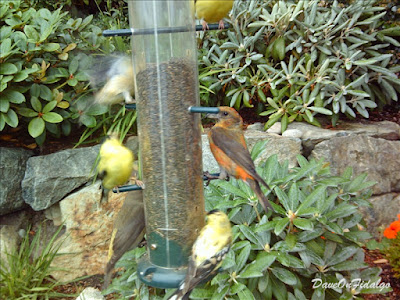
The American Goldfinch ( Carduelis tristis ) is the state bird of Washington, as well as of Iowa and New Jersey.  On Fidalgo Island, we see them from spring to late fall.  They are year-around residents of eastern Washington. These are Birdcam photos and it has been surprisingly difficult to get decent shots.  The breeding plumage of the male is so intensely yellow that it tends to over-saturate, especially in sunlight.  The best Birdcam photos are produced in shade or under overcast skies.  Even then, they need a little Photoshop hocus-pocus to make them presentable. This is a breeding season pair which allows comparing the plumage of the male and female.  The male on the right is bright, clear lemon yellow with a small, black cap on the forehead.  The female is drabber, grayish yellow-brown and lacks the cap.  In he winter, the males lose their black cap and become drab olive or brownish like the females. The older binomial is Sp...

Birdcam Sabotage and a Lesson

Image
Webster's New World Dictionary defines "sabotage" in part as: "Destruction of railroads, bridges, machinery, etc., as by enemy agents or an underground resistance." "The deliberate obstruction of or damage to any cause, movement, activity, effort, etc." This is the current state of affairs at my Birdcam 2 station in the back yard.  The key words in the definition are "enemy agents," "deliberate," and "damage."  In this case, the enemy agents are the non-native Eastern Gray Squirrels ( Sciurus carolinensis ): This Birdcam photo shows the suet feeder under attack when it was still relatively undamaged.  For several weeks I had been getting virtually nothing but squirrel photos at the Birdcam from dawn to dusk.  Two entire cakes of suet would be consumed in a single day.  The situation was insufferable.  I took some steps to try to solve the problem.  You can see these in the photos: I used a more robust lat...

The Bad Seed

Image
More accurately, a bad choice of seed as a lure at the Birdcam can produce unexpected results.  In a previous post I mentioned setting up the Birdcam station with a mix of sunflower and safflower seed.  This was done in an effort to catch another photo of a Red Crossbill.  The lure was successful, but not in the way I anticipated.  It became obvious now was not the best time of the year for this mix of seed. On the first day, I got more than 1,200 shots, but no Crossbills.  On the second day, the Birdcam captured over 1,500!  From last Friday, I was facing 1,729 photos which was almost the full capacity of the SD card.  Obviously, the word was getting around in Birdland that there was a great new restaurant in town.  In all those photos, not a single Red Crossbill could be found.  Instead, I was getting mostly House Finches and House Sparrows together with dozens of their fledglings. The biggest problem was the prospect of deali...

Rara Avis:  Red Crossbill

Image
This is a Birdcam photo that would normally have been discarded due to blurred images.  The orange-tinged bird on the right, however, provided a reason to reconsider.  I have had nyjer seed set up at Birdcam One in order to catch some shots of Goldfinches.  I have gotten some nice ones and will present those here a bit later.  This bird is a Red Crossbill ( Loxia curvirostra ) and this photo marks only the second time I have seen one in the yard.  Even though his head is partly obscured by the perch, the occasion is important enough to present it here.  If you look closely, you will see how his upper bill curves over the left side of the lower bill.  Both bill tips curve past each other giving the bird its name. The first time I saw a Red Crossbill in the yard was about twelve years ago.  This was a brilliant brick-red male with dark brown wings.  He spent a good twenty minutes preening on a post.  The bird in the photo is probabl...

Pine Siskin: First Look

Image
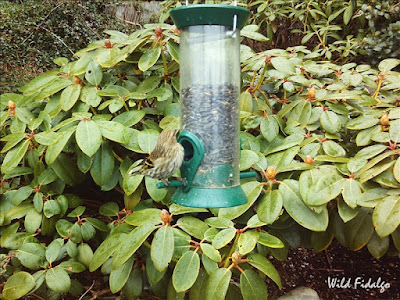
After changing seed to black sunflower, another species has debuted at the BirdCam station.  Here are the first images caught of a Pine Siskin ( Carduelis pinus ) since installing the camera last fall.  These finches are said to be year-around residents in our area, but I see them only rarely.  They resemble American Goldfinches in winter plumage, except they have a lot of brown streaking the Goldfinch lacks.  The name " Carduelis " implies they are also fond of thistle seed ( carduus is a thistle).  Later this spring, I'll be putting up a thistle feeder to what that will attract. According to BirdWeb , my yard provides their desired habitat, "semi-open areas, including forest edges and weedy fields."  Well, let's hope not too weedy.  They nest on horizontal branches of large conifers which I also furnish, so perhaps I'll have a nesting pair or two. The BirdCam station is currently in a fairly open area of the yard, and near the house.  I ...

February 23rd

Image
Snowfall is not a common occurrence in the Puget Sound lowlands.  If we get any, it usually comes between late November and early January.  Sometimes we don't even get frost until late December or January.  Other parts of the US have been clobbered by repeated waves of heavy snowfall this winter.  In the Pacific Northwest, we have tried to keep a low profile, hoping to escape La NiƱa 's attention. When February arrived, we thought we had staved off any chance of snow for the winter, but no such luck.  On February 23, 2011 a Pacific low positioned itself off the coast in a perfect location to draw Arctic air down the Fraser Valley into Puget Sound.  At the same time, it pushed moisture from the ocean into western Washington.  This was a recipe for heavy snowfall and it came very quickly.  For a time, 30 miles of Interstate 5 was shut down in Skagit County north of Seattle where drivers where overwhelmed by the volume of snow.  Up to 14 in...