Posts

Showing posts with the label Shorebirds

Black Oystercatchers Nesting

Image
I consider the pair of Black Oystercatchers (Haematopus bachmani) that make their home in the Kukutali Preserve to be friends.  I have been watching them since 2011 , the first time I visited.  I'm fairly certain I have been seeing the same birds every year.  According to BirdWeb , "Males and females appear to form long-term pair bonds, and the pair returns to the same territory year after year." I was in the Preserve yesterday and found them in their usual spot, where they appear to be nesting now.  They seem to nest later in the season than other birds.  I'm not certain, but perhaps it's a shorebird thing.  Land birds are pretty much done with that now, or even getting ready for a second brood.  Oystercatchers lay their eggs in a simple scrape in the rocks, above the high tide line, according to the iBird app . While I walked up the beach to the west, I pointed the camera at some gulls that were still quite a distance away.  Only th...

Pigeon Guillemot

Image
This week's visit to the Kukutali Preserve , brought another "first sighting" for me.  Just offshore of the Flagstaff Island beach, I spotted this pair of Pigeon Guillemots (Cepphus columba) in their elegant breeding plumage.  At first I saw just a single bird (above), then realized there was a second nearby.  They are year-around residents of the Salish Sea . Pigeon Guillemots are birds of inshore waters around rock shores.  According to BirdWeb , they nest in rock caves or crevices or under driftwood.  Given these preferences, this pair could well be nesting somewhere here in the Preserve.  Pairs may join small colonies or nest singly.  These are diving birds that use their wings to propel themselves underwater.  Their diet includes fish, mollusks and crustaceans. These are not ducks.  Guillemots are grouped in the family Alcidae , which includes puffins, auks and murres.  This black and white plumage is typical of the g...

Heron Luncheonette

Image
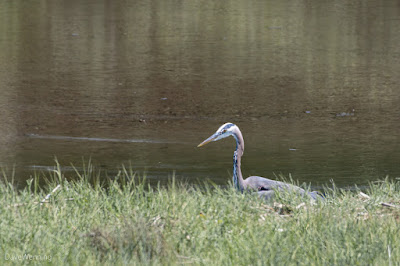
On Memorial Day I hiked around the Kukutali Preserve .  It is a favorite and convenient spot for me, quick and easy to get to and I always find something interesting there.  At the end of the hike, I headed back along the tombolo connecting Kiket Island to the mainland.  There is a lagoon on the north side of the tombolo.  Over the bank separating the roadway from the lagoon, I spotted a Great Blue Heron (Ardea herodias) giving me the eye. In itself, seeing a heron around here is not unusual.  What did strike me as odd, I was well inside the " escape zone " from which herons will usually flee, barking in protest.  This one did not flee, however, but remained in place watching me. As I continued along the tombolo, I got even closer and was able to get a better view of the bird.  It was wading belly deep in the lagoon.  Still, it did not flee from me.  It just stood there motionless. Then, quite suddenly, the bird plunged its h...

Homecoming

Image
These  Black Oystercatchers (Haematopus bachmani) have come home to their nesting site in the Kukutali Preserve .  When I visited the island this morning, I was treated to a little courtship song and dance. They always leave their nesting site during the winter to join their friends over on Fraggle Rock at West Beach in Deception Pass State Park.  But now they are home for the summer to raise a brood of youngsters.  Pairs are monogamous and usually return to the same isolated nesting sites every year.  I have been observing this pair since 2011. Note that I am taking these picture from a good 100 feet/30 meters away with a telephoto lens.  Visitors to the Kukutali Preserve should be respectful of this nesting site.  If you come to visit, please be careful not to disturb the birds.

Three Good Bets for Winter Birding

Image
There are no certainties in birding, but there are places where it is possible to come close.  In the very heart of the Salish Sea , Deception Pass State Park offers great spots for viewing three special birds. Black Oystercatchers (Haematopus bachmani) During the fall and winter, look for them at West Beach resting on the large rock just offshore from the parking lot.  Mid to late morning seems to be the best time.  This is one of the few spots where they can be viewed inland from the Pacific coast.  The numbers that congregate here are also unusual.  Laid back, peaceable and a bit quirky, I consider them the most charming of all shorebirds. Bald Eagle (Haliaeetus leucocephalus) Also at West Beach, there is a resident pair of Bald Eagles that can often be seen perching at the edge of the Dune Forest.  Like most predators, eagles spend a lot of time resting.  They can usually be seen in the tallest trees at the north end. ...

Gulls Are Hard

Image
Gulls can be notoriously difficult to identify.  They change appearance with age and the season.  To add to the complexity, some species readily interbreed to produce hybrid offspring. This is the case with Washington's Western and Glaucous-winged Gulls.  According to Sibley , hybrids of the two may be more abundant here than either of the two individual species. This is why I am calling this one a hybrid of the Western Gull (Larus occidentalis) and the Glaucous-winged Gull (Larus glaucescens) .  Both species have dark eyes, pink legs and a heavy bill with a red spot.  The wing tips of the Wedstern are black while those of the Glaucous-winged are light gray like the mantle.  This bird's wing tips are dark gray.  Of course, I could be completely wrong.  Like I said, gulls are hard. In the Kukutali Preserve , there is a driftwood log that that juts out over the beach.  It is propped up on a large rock.  There is always a g...

Giving Eagle His Space

Image
Recently, I hiked the Bowman-Rosario Trail out to Rosario Beach in Deception Pass State Park .  At the beginning of December, we had a stretch of clear skies and cold temperatures.  For me, this is ideal weather for hiking and exploring. Big rocks out in Bowman Bay are visible from the trail.  On the map, I believe these are the ones identified as Gull Rocks.  Usually, they are populated with dozens of cormorants, a real spectacle.  These are diving birds that like to gather together in such places to dry their feathers, preen, rest and socialize after fishing.  Such a group is called a "sunning."  On this morning, however, there were no cormorants.  I spotted just a single bird, a Bald Eagle (Haliaeetus leucocephalus) perched on the rock in the early December morning sun. Here's a closer view of the eagle taken further along the trail.  I doubt this is a good vantage point for spotting fish in the bay.  Like other predators,...

A Parcel of Oystercatchers

Image
A group of Black Oystercatchers (Haematopus bachmani) is called a parcel according to iBird Pro .  I found this group resting on Fraggle Rock this morning.  Recall, this is the name I gave to the rock just offshore at West Beach in Deception Pass State Park.  I have never been able to find an official name for it. This is a favorite late morning resting spot for shorebirds, especially gulls and cormorants.  During the fall and winter, Black Oystercatchers also like to congregate here.  They come to rest and socialize.  It is always a peaceful gathering.  I have never seen any squabbling among the different species here. Humans, of course, bring another story.  While I was taking photographs, these people started throwing rocks at the birds.  They didn't stop until every bird was driven from the rock.  Apparently, they thought that was appropriate behavior.  The birds were gone and my photo session was over.  Tha...

Black Oystercatcher at Kukutali Preserve

Image
Just across Skagit Bay from my home is Kiket Island and the smaller Flagstaff Island attached to it by a tombolo .  The islands now comprise the Kukutali Preserve .  It is owned and operated jointly by the Swinomish Tribal Community and Washington State Parks.  Until this week, access to the Preserve was limited to small guided groups by reservation only.  It is now open to the public and I made my first unescorted visit last Tuesday.  You can read about my visit and the history of this newly opened nature preserve at Fidalgo Island Crossings . With a good low tide, I returned this morning with a specific objective.  I wanted to see if the Black Oystercatchers (haematopus bachmani) I first met three years ago are still living at Flagstaff.  I spotted a pair calling and flying low over the bay towards Skagit Island on Tuesday. Sure enough, today I was rewarded by another encounter with one of my old friends.  Oystercatchers are non-migrat...

A Murder at West Beach

Image
October 11, 2013 was a big day for wildlife at West Beach in Deception Pass State Park.  A half dozen Bald Eagles were fishing just off the beach.  The Mayor was working his pine grove and the Heermann's Gulls , had joined all the other sea birds at "Fraggle Rock."  Not to be outdone, about a dozen or more Northwestern Crows (Corvus caurinus) were patrolling the beach next to the picnic grounds.  Such a group of crows is called a "murder."  Other collective nouns for crows include "cauldron," "congress," "horde" and "muster" according to iBird Pro . While I watched the crows doing their crow chores on the beach, one fellow seemed to be more interested in studying me.  That's him in the photo above.  I'd be curious to know what he learned. Northwestern Crows make their living beachcombing the intertidal areas of rocky shores.  For this reason, these Corvids could be classified as shorebirds.  Th...