Posts

Showing posts with the label The Wild Life

City Folk

Image
Since I last posted here, I moved to a new house.  I am now living in Anacortes, right in the middle of the city.  Interestingly, this place doesn't seem to be any less wild than the rural location where I was before.  This doe and fawn are just one of the families that pass through here every day.  These are indigenous Columbian Black-tailed Deer , Odocoileus hemionus columbianis .  I had just come home from a hike and spotted them in the cul-de-sac in front of my house.  I took this photo from the car. Here's a shot taken through my living room window the other day.  She just decided to take a rest in back yard.  I regularly see two does with fawns, one with twins and one with a single offspring.  I also see one with no offspring, and this may be her. Then, there was this guy that passed through the back yard early this morning.  I have motion-activated video cameras around the house that are catching a lot of the goings-o...

Madronas and Deer

Image
The Madronas at Deception Pass are amazing this year.  I have never seen the abundance of fruit on the trees like they have right now.  Yesterday, I went over to the State Park to get some photos of the trees.  While at the top of Goose Rock, I made a couple of new friends, a pair of young Columbian Black-tailed Deer (Odocoileus hemionus columbianus).   As usual, I went hiking to find one thing, and ended up finding something else unexpected.  Surprise encounters like this are always the best. The pair were not fully grown.  If I can use the observations from my own yard , I am guessing these are siblings.  After they leave their mother's side, they will stick together for a few years until they mature. Another habit exhibited by deer is a tendency to follow the same trails and routes from day to day.  I have also seen this in my yard.  That would mean this pair could be frequent visitors to the top of Goose Rock, the highest poin...

An Eagle for Boxing Day

Image
On the day after Christmas, Boxing Day is observed in many English-speaking countries around the world.  For some reason, it is well known, but only erratically observed in the United States.  Mostly, we use it as an excuse to take another vacation day after Christmas. My Christmas present this year was a new Canon EF 100-400mm II telephoto lens.  Among the first subjects I wanted to photograph with it were the Black Oystercatchers on "Fraggle Rock" in Deception Pass State Park.  Winter is the best time to find them there.  On Boxing Day, I headed over to the park with the new lens. When I got there, I was pleased to find several dozen Oystercatchers on the rock.  Just as I was getting ready to shoot, some ignorant, yahoo tourist started throwing things at the birds.  This is the second time I have observed this behavior in the same spot.  The gulls weren't bothered, but all of the Oystercatchers flew off, about fifty in all.  My s...

Uncle Robin

Image
Uncle Robin, that's me!  An American Robin (Turdus migratorius)  picked the fuchsia basket on my entry porch to build her nest.  Needless to say, this has made watering and picking off old blooms a bit complicated.  I am basically banished from the porch. The fuchsia needs to be watered two or three times a week.  The method is to peek out and find a moment when the parent is not there.  Then quickly go out and water around the sides of the nest before dashing into the house again.  I've given up on picking off the old blooms to keep it flowering.  The birds are more interesting anyway. When she was sitting on eggs, she rarely left the nest.  Now she has three little mouths to feed and this is keeping her busy from dawn to dusk.  While she's out foraging, I get a chance to go out and water. Dad might be helping out with the feeding.  With the poor lighting, it's hard to tell, but that could be Mom in the first photo, Da...

Robin Thinks He's a Shorebird

Image
On Labor Day, I took a nice long hike up the beach into Similk Bay .  I never know what I will encounter on my beachcombing treks.  I certainly did not expect to find this American Robin (Turdus migratorius) .  He was busy patrolling the driftwood that had collected along the shoreline. Silly Robin!  You don't belong on the beach.  This is the place for Gulls and Oystercatchers and Northwestern Crows.  Canada Geese, Ravens and Herons use this place.  Sandpipers and Killdeer live here.  It's not for thrushes like you.  Your place is open woods, forest edges and meadows, gardens and city parks.  You should not be hopping around the driftwood on a salt water beach. Well, look at this.  You found a tasty bug in the rotted center of that driftwood stump.  You have also been getting into those ripe blackberries growing along the shore.  I can tell by the stains on your beak.  I guess you belong here after all...

Red Crossbills of Gibralter Road

Image
The Red Crossbill (Loxia curvirostra) was the bird that led me to bird watching.  I had recently moved into this house, and as I recall, it was late August.  The house was new and there was no yard yet.  I spotted a bright red bird with dark brown wings.  It was perched on an Alder snag and preening.  I had no idea what it was.  In the late afternoon sun, the red color was brilliant, almost glowing.  I tried to memorize everything I was seeing.  The important thing I could not see from a distance was that unique bill. I bought my first bird book, a Peterson Field Guide to Western Birds, because of this sighting.  Using the book, I tentatively ID'd it as a Scarlet Tanager, but I had doubts.  It did indicate they were "accidental" in the Pacific Northwest.  The picture of a Red Crossbill in that book looked pink to me, and my bird was brick red, more like the Tanager. Now, move ahead in time about 12 years.  Add a b...

Herons

Image
Autumn Blue Heron She is dancing with the wind Taking flight with me Skagit River Delta, Fir Island, Washington Quiet visitor Softly singing with the wind Music of the earth Skagit Bay, South Fidalgo Island, Washington

Predator

Image
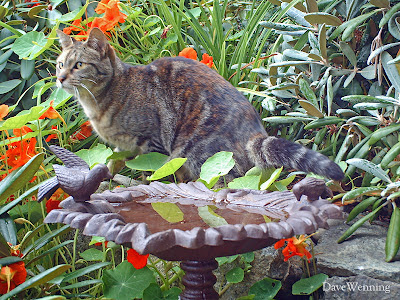
Arguably, the film Predator gave us one of the greatest movie creatures ever.  It took cunning and some luck for Arnold to defeat it.  Our wildlife gardens can also contain predators that are as malevolent and ruthless as that alien creature in the movie.  Domestic cats that are allowed to run free are known to exercise their predatory instincts.   One blogger did the math and came up with an estimate of 1.7 billion birds killed by outdoor cats annually in the United States.  If you think that is an overestimation, divide it by 1,000 and the number is still too large. If cat lovers are not feeling a little concerned by that number, perhaps they will take notice of these figures : Free-roaming cats live 1 to 3 years Indoor/outdoor cats live 6 to 8 years Indoor only cats live 20 years or more My neighborhood serves as an example.  When I first moved here, there were several cats, perhaps a dozen, that roamed the area.  I came to recognize ...

Banana Slug, Hooray!

Image
I am about to wax rhapsodic over finding a slug in my garden.  I know some may find that weird, but remember, this is the Pacific Northwest.  We're a little different here . This lovely lady (or handsome gentleman, if you wish, you can use either since they are both) is Ariolimax columbianus , the Banana Slug .  If you're lucky, you can find him/her in the foggy, moist coastal forests from southeast Alaska to northern California. These are not the garden pests that climb your Lupines, gobble up your Hostas or feast on your Petunias.  Those gray, red or black invaders are immigrants from Europe.  Our native Banana Slugs have a refined and gentle palate.  They are more likely to be found cleaning up decaying plant material from the ground.  According to Paghat's Garden , they prefer densely wooded places where there are lots of mouldering conifer needles to eat.  Mushrooms are their favorite food . Why am I excited about finding one in my g...

Heron in Haiku

Image
A great blue heron Softly singing like the tides Taking flight with me Heron in the marsh Moves silently with the earth Welcoming the sun The blue heron speaks You are laughing at the rain I know this is home Morning blue heron Takes flight warmly with the dawn Spirit of this place Waiting blue heron She is speaking for the earth Awakening us Sunrise on the marsh Blue heron greeting the dawn Taking flight with her Tranquil blue heron The tides speaking with the earth The song of moonlight Heron in the mist Whispers softly like the dawn The name of the earth Blue heron at dawn Tells a story to the tides The song of the earth Misty yellow sun Awakening with the marsh A heron takes flight Ripple in the marsh The dawn shifting to the past Heron awakens Resting blue heron The sea smiling with the day Taking flight with him The visitor speaks Awakening like the sun I know what we are Visiting a Great Blue Heron in the tidal marshes of th...

Meet ArtMagenta

Image
We wildlife enthusiasts spend a lot of time nourishing our left brains with data about taxonomy, habitats, ranges and the like.  If you are like me, you want to know everything possible about the species you see.  Sometimes these pursuits leave little opportunity for the right brain's imagination and creativity.  Even with wildlife photography we can get caught up in the technical details of a photo instead of stepping back to enjoy the "big picture." How great it is to discover a wildlife blog that seems to be designed for the right brain.   Ulf Andersson is an illustrator in Sweden who goes by ArtMagenta on the internet.  He publishes the blog Bird of the Day .  Don't worry, you don't need to tala svenska to read it since his posts are in English.  For me, the drawings evoke a Japanese style of painting, simple, elegant and colorful.  Rather than portraying fine anatomical detail in his birds, he gives us wonderful caricatures that di...

Becoming a Backyard Wildlife Sanctuary

Image
Chestnut-backed Chickadee ( Poecile rufescens ) on Dogwood Reconsidering the NWF My yard is a Certified Wildlife Habitat by the National Wildlife Federation.  Their banner, currently in the upper right corner here, has been proudly displayed.  Thanks to information from Kelly Brenner ( @MetroFieldGuide , Google+ ) and Carol Sevilla Brown ( @CB4wildlife , Google+ ) , I have learned that the NWF has apparently entered into a partnership with Scotts Miracle-Gro®.  This is the familiar garden fertilizer and pesticide company and a division of the Big-Ag chemical company ICL.  A firestorm has erupted over this news.  To those of us seeking to create natural, sustainable habitats in our yards, the very idea of this partnership is bewildering, to say the least. While this gets sorted out, those of us in Washington State have an alternative.  The Washington Department of Fish and Wildlife also has a Backyard Wildlife Sanctuary Program .  I am apply...