Posts

Still Seeing Spots

Image
Spotted Towhees ( Pipilo maculatus ) are common year-around birds on South Fidalgo Island and throughout the Pacific Northwest.  A previous post from early March revealed the discovery of Towhees here with more spots than we usually see.  They seemed to be birds normally seen further east and south which wandered into our area.  In a subsequent post , these variants were identified by Greg Gillson as P. m. 'curtatus' or Nevada Towhees.  Their normal range is southeast British Columbia, eastern Washington, through Idaho, Nevada and into southeastern California.  Our local 'oregonus' variants of the Northwest coast are much less spotted as exemplified by this female: At the time, the question was whether these spottier birds were just winter visitors or migrants passing through.  Since I am still catching photos of them at the BirdCam stations, it is beginning to appear that some may have settled here permanently.  Perhaps this is the beginning o...

You Again!

Image
Eastern Gray Squirrel ( Sciurus carolinensis ) I was wondering how long it would take this guy to discover that there were sunflower seeds back at the BirdCam station.  It took him a little more than two weeks.  You're slipping up there, fella.  Looks like it's time to switch to safflower seed again.  We'll see what that will attract now that the spring birds are starting to return.

Townsend's Chipmunk

Image
As already noted, more than birds are seen at the BirdCam station.  This is a Townsend's Chipmunk ( Tamias townsendii ) said to be one of the largest of the western chipmunks.  It is also called Neotamias townsendii , but I don't know why.  They belong to the Sciurid family along with squirrels, marmots, woodchucks and prairie dogs.  They are named after naturalist John Kirk Townsend . Their range extends from the southwest corner of British Columbia through western Washington and Oregon.  Their colors are darker than other chipmunks, explained as a characteristic of species living in moist climates.  I haven't quite reasoned that out yet.  Coloration is sometimes an adaptation for camouflage.  Perhaps it's because our landscape colors tend to be darker than, say, the pastels of a desert. Of all the creatures that visit the garden, these are among the most appealing.  I have never minded them visiting the feeders.  They're not ...

Spotted Towhee at Rosario Beach

Image
Spotted Towhee ( Pipilo maculatus ) From Fidalgo Island Crossings , spring arrived for real on March 23rd.  In Deception Pass State Park, this Spotted Towhee caught my attention at Rosario Beach.  All by himself, he was joyfully singing, completely caught up in the moment.  After a long winter, I felt the same way on this beautiful, sunny day.

BirdCam No. 2:  Photo Management

Image
Chestnut-backed Chickadee ( Poecile rufescens ) Having just installed a second BirdCam station, I am already getting activity.  I have also discovered some nifty software for managing and editing photos.  In BirdCam No.1, I am using an Eye-Fi SD card which transmits images to my laptop via Wi-Fi.  It works well, but also has some drawbacks.  For BirdCam No.2, I decided to go with a standard SD Class 6 card.  This meant I needed software that would download the images, sort them into subfolders by date and keep track of images already transferred.  I don't like the way Picassa and Windows Live Photo Gallery want to take over everything.  Sometimes I like to root around in my folders on my own and use the Windows Photo Viewer.  I also don't like the way WLPG will save changes without asking. After some study, I settled on FastStone Photo Viewer now in version 4.3.  I am tickled to death with it and it's free to boot.  It is very fa...

Another Day, Another Birdcam

Image
This may qualify me for the "Off-The-Deep-End" list, but I have installed a second BirdCam.  This one is sited at the edge of a canopy formed by large Douglas Firs, with an understory of smaller trees and garden plantings.  The so-called " edge effect habitat " is known to be ideal for wildlife diversity and sightings.  Hopefully this concept will also apply to backyard landscaping. Siting a BirdCam station is similar to locating feeders, with a couple of extra considerations: Close to cover and escape routes so the birds will feel safe Straightforward access for both birds and people Convenient to the house to make it easy to replenish feeders and to inspect and maintain the BirdCam Away from predators such as cats (our local coyotes take care of that) Away from nest boxes; feeder traffic may discourage use of nearby nest boxes Good lighting for photos as with any camera; the BirdCam tends to produce blurry or poor quality images in low light Sheltered fr...

Pine Siskin: First Look

Image
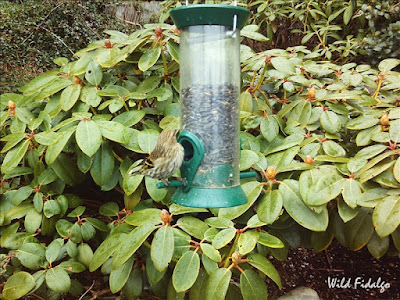
After changing seed to black sunflower, another species has debuted at the BirdCam station.  Here are the first images caught of a Pine Siskin ( Carduelis pinus ) since installing the camera last fall.  These finches are said to be year-around residents in our area, but I see them only rarely.  They resemble American Goldfinches in winter plumage, except they have a lot of brown streaking the Goldfinch lacks.  The name " Carduelis " implies they are also fond of thistle seed ( carduus is a thistle).  Later this spring, I'll be putting up a thistle feeder to what that will attract. According to BirdWeb , my yard provides their desired habitat, "semi-open areas, including forest edges and weedy fields."  Well, let's hope not too weedy.  They nest on horizontal branches of large conifers which I also furnish, so perhaps I'll have a nesting pair or two. The BirdCam station is currently in a fairly open area of the yard, and near the house.  I ...