Posts

House Finch

Image
House Finch ( Carpodacus mexicanus ) The House Finch ( Carpodacus mexicanus ) is native to the southwestern United States and Mexico.  According to BirdWeb , they prefer edge habitat and have followed human alterations and agricultural expansion.  They arrived in western Washington in the 1950's and are now common throughout the state.  In 1940, caged birds from the illegal pet trade were released in New York.  This became a source of territory increase in the East.  Bird lovers may have also played a role in their expansion.  House Finch distribution is apparently associated with the presence of bird feeders.  They outcompete Washington's natives, Purple and Cassin's Finches, and are the major cause of the Purple Finch's decline in western Washington.  American Goldfinches, our state bird, do not seem to be similarly affected. iBird tells us that a group of House Finches is known as a "development."  Male House Finches bear the rosy c...

My Little Chickadee

Image
Chestnut-backed Chickadee ( Poecile rufescens ) These charming little birds are common year-around residents on South Fidalgo.  Our coniferous woodland habitat probably accounts for this.  The Chestnut-backed Chickadee ( Poecile rufescens ) was the very first species caught on my newly installed BirdCam.  They are frequent and fearless visitors.  If I am working on the front patio they will come to the feeders there without trepidation.  Then they try to run me off with their " chip-chip-chip " calls.  I like the lack of intimidation towards people by these little guys.  They usually come singly, but once in a while I get two or more at the feeders... Sometimes all is not peaceful on South Fidalgo.  When a third Chickadee arrives, he displays by puffing up his head... Is he trying to run off the other birds the way they try to run me off?  Of course, his companion is having none of it... OK, I'm outta here...

Last Look

Image
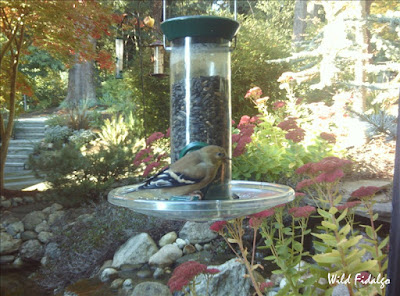
American Goldfinch ( Carduelis tristis ) Ordinarily, I probably wouldn't have noticed this bird at the feeders.  The closeup afforded by the BirdCam reveals an American Goldfinch ( Carduelis tristis ) taking on winter coloration.  With grayish tones on the front and sides, it is probably a female.  Our state bird, they are abundant on South Fidalgo in the spring and summer.  In the fall, however, they always disappear, apparently preferring warmer climes.  This may be one of the last stragglers.  In somewhat awkward lighting, I caught four shots of her on October 19th, then none after that.  Here is one more...

Varnish Clam

Image
Varnish Clam ( Nutallia obscurata ) From Fidalgo Island Crossings , most things on the beach come in shades of gray and other earth tones.  In such a setting, something glowing purple catches your eye.  These are the empty shells of the Varnish Clam  ( Nuttallia obscurata ), a recent immigrant from Asia.  The outside of the shell is nondescript and can be seen at the larger shell's 10 o'clock position.  It does look as if it has been varnished.  They are thought to have been first introduced into the Strait of Georgia near Vancouver, B.C. in the late 1980's.  The dumping of ballast water by Asian transport ships is the probable source.  These empty shells were spotted near Similk Bay .  They are the likely victims of predation by Dungeness Crabs .

Great Blue Heron

Image
Great Blue Heron ( Ardea herodias ) A Great Blue Heron ( Ardea herodias ) takes a break from foraging off the South Fidalgo shore.  They are daily visitors and I have noticed an interesting behavior while they feed.  The birds will space themselves respectfully 100-200 feet/30-60 meters apart along the beach.  They become alarmed if they get too close together and quickly rearrange themselves.  While they seem to prefer foraging in isolation, they nest in crowded rookeries that can number several hundred pairs.  This bird is probably from the March's Point Heronry with nearly 400 nests at the present time.  When running, you can see what is happening there on the live Heron Cam .  Another rookery can be found on Samish Island nearby.  The local birds have some rather expensive tastes which include Japanese Koi from my pond.

Downy Woodpecker

Image
Downy Woodpecker ( Picoides pubescens ) A bird slightly longer than the suet cage identifies a Downy Woodpecker ( Picoides pubescens ).  The very similar Hairy Woodpecker is about 2 inches larger.  I have caught him before, but until now, always with his back to the camera.  At least we get a good look at his red mark.  Females lack the red mark on the back of the head: Female Downy Woodpecker with a Trio of Juncos Downies are North America's smallest woodpeckers.  Nevertheless, in their black and white garb, they are also among the handsomest of birds.  I have never seen more than one at a time, but if you encounter a group, call it a "descent," "drumming" or a "gatling" of woodpeckers according to iBird.  Here on South Fidalgo, they are common visitors at the feeders in fall and winter.

Northern Flicker

Image
Northern Flicker ( Colaptes auratus )  From Fidalgo Island Crossings , the Northern Flicker ( Colaptes auratus ) is among the commonest birds visiting the feeders, and one of my favorites.  In the spring, they love to drum on the metal chimney cap of my fireplace.  ...at 5:30 in the morning.  A lack of moustache mark in this bird identifies a female, but other markers are problematic.  In the West, our resident Northerns are the Red-shafted race, but Yellow-shafteds are known to visit Washington in the fall and winter.  She appears to have yellow-shafted tail feathers, but lacks the red nape mark of the Yellow-shafteds.  My best guess is she is a juvenile Red-shafted Northern Flicker who has not yet acquired adult coloration, or a hybrid intergrade.  I would appreciate hearing from anyone with a better idea. According to iBird , a group of flickers is called a "guttering," "menorah," or a "Peterson" of Flickers.  I have experienced Pe...